RF Catcher
RF Recording and Playback Technology
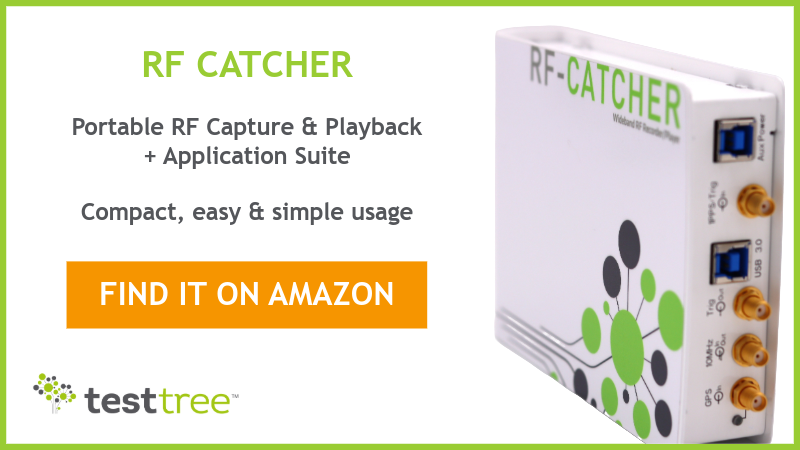
Modern RF Catcher allow professionals to record complex radio environments across wide frequency ranges and replay them with precision. Devices like the RF-Catcher from TestTree demonstrate how portable RF recording systems can capture live signals in the field and reproduce them in the lab for testing and analysis. These systems are widely used in telecom, broadcasting, lab environments, and advanced engineering workflows to reproduce real-world RF conditions accurately.
This guide explains how RF recording works, describes leading signal catcher devices like RF-Catcher, and compares key characteristics such as dBm levels, bandwidth, and hardware capabilities. It also highlights practical tool features, file handling, and flexible options for multiple application areas.
What Is RF Recording and Playback?
RF recording systems capture live radio activity and store it for later playback, enabling users to record identical conditions across numerous scenarios. Devices like the RF-Catcher support MHz to GHz ranges, handle up to 55 MHz real-time bandwidth, and store high-fidelity data for lab replay.
How It Works
A typical workflow includes:
- A compact RF frontend (catcher) for field acquisition
- High-performance hardware capable of handling wide frequency range signals
- Configurable input sources for multi-channel acquisition
- Controlled output stages that reproduce dBm power conditions
- Real-time views using spectrum analyzers and an integrated analyzer for visual inspection
- High-speed storage for large data sets
- Optional automatic trigger functions to detect events
The RF-Catcher is USB-powered, portable (~600 g), and supports drive tests, lab replay, and app-based control for easy operation.
Applications of RF Capture Technologies
RF recording solutions support a wide array of professional applications, including:
Telecommunications & Wireless
- Field record sessions to assess frequency occupation in MHz/GHz bands
- Verification of dBm power stability across cellular or broadcast network sectors
- Capturing real radio conditions during test campaigns
Aerospace & Defense
- High-fidelity capture of mission-critical RF activity
- Replay of complex RF conditions for controlled evaluation
- Portable systems for field deployment
Broadcast & Digital Services
- DVB signal characterization
- Continuous monitoring of spectrum usage
- Using app controls to quickly assess field results
Engineering & R&D
- Development of new RF waveforms
- Long-duration captures with precise input and call parameters
- Using analysis tool for in-depth inspection
- Managing large data sets from multiple sources
The RF-Catcher makes it possible to bring field measurements directly into lab workflows for advanced evaluation.
Key Features of the RF-Catcher
- Compact and lightweight (USB-powered, ~600 g)
- Wide frequency range: 70 MHz – 6 GHz
- Real-time bandwidth up to 55 MHz
- Adjustable output dBm levels
- Multi-format file storage for IQ data
- Two configurable RF input channels (cannot be used simultaneously)
- Supports DVB, cellular, Wi-Fi, and other radio standards
- Integrated spectrum analyzers and analysis tool for visualization
- Optional automatic trigger for event detection
- Compatible with app-based control and workflow suite
- Portable for drive tests and lab replay
Comparing RF Capture Devices
When evaluating RF recorders, consider:
1. Frequency & Bandwidth Range
Determine the required frequency coverage, whether MHz or GHz, and the real-time bandwidth needed for your signals.
2. Storage & Power
High-speed storage is critical for long record sessions. Ensure sufficient dBm output for playback in lab tests.
3. Analyzer & Tools
Look for devices with built-in analyzer, visual tools, and compatible suite or app for easy management.
4. Application Type
Select the appropriate type for lab operation, field radio work, DVB monitoring, or network validation.
5. Options & Expandability
Manufacturers may offer extended range, additional file formats, or advanced automatic trigger options for more complex test campaigns.
How to Choose the Right RF Recorder
Key considerations:
- What signals and frequency ranges do you need to record?
- Do you need multiple input channels or high dBm outputs?
- Are portability, compact hardware, and GHz output important?
- Which analyzer, tool, and workflow options are critical?
- How will you manage large data sets and long time sessions?
Selecting the right device ensures precise recording, accurate playback, and reliable operation across diverse RF scenarios.